
Steelhead Fishing Series
"WADING the RIVER!"
with Barry M. Thornton
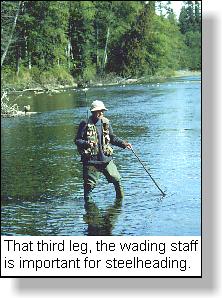 Standing quietly on the river trail, I watched the beaver
swim and drift downstream with the current and gave a
silent prayer, for the thousand's time, to this friend of
the steelheader. How many times, I asked myself, during
many winter steelheading seasons, had I watched their
engineering progress on a streambank fallen alder or
evergreen that had effectively blocked a pool or shallow
riffle. They had gnawed until all branches were stripped
or cut off thereby releasing the trunk to drift
downstream but, up against the riverbank, and clearing it
from a steelhead holt. How many times I thought, as he
disappeared downstream, had they chewed that solid third
leg which I had picked up on the riverbank. That natural
staff which had propelled me safely across uncountable
rain swollen rapids? Yes, the beaver is more than just a
friend of the steelheader, he could easily be called
their totem. He ensures clear fishable streams, headwater
nurseries, and, supplies a solid light wading staff
unmatched by any manufacturer or advertised in any
catalogue.
Many years ago I purchased one of those lightweight
telescopic aluminium wading staffs only to find when it
was put to a severe test, that one of the extensions
would slip throwing me off balance. Once, I remember only
too well, I fell head first into cold February waters
when an extension tube suddenly gave way leaving me
soaked many river bends from my truck. This reminder of
our technical world still hangs on a peg at home but,
now, it is almost hidden by the collection of beaver
chewed lightweight wooden staffs that I have since
collected along numerous riverbanks.
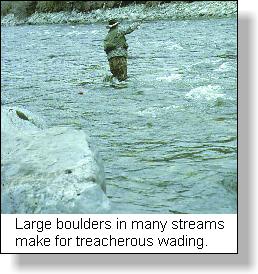 River wading is one of the most
important skills stream anglers need to master if they
are to be consistently successful and enjoy a day's
fishing. It is a skill which is mastered only after many
years of experience but, there are some tips which can
hasten this mastery. While the majority of coastal
streams can be crossed there are a few, even though they
appear small, should never be waded because of
treacherous large boulders which are impossible to
negotiate safely. On the other hand, the majority of
coastal streams have culminations of sand and small
gravel that allow for easy crossing. You must be the
judge of your experience and the underwater debris that
you face. Wading has greatly increased my steelheading
success over the years and has allowed me to beach many
wild run-out steelhead that have gone downstream when
they have been hooked. I am an aggressive wader because I
can swim and I wear floater safety coats while on the
river. But, decades of wading, while giving me greater
opportunities to hunt for steelhead, have also taught me
to always test the water current before I commit myself
to cross. River wading is one of the most
important skills stream anglers need to master if they
are to be consistently successful and enjoy a day's
fishing. It is a skill which is mastered only after many
years of experience but, there are some tips which can
hasten this mastery. While the majority of coastal
streams can be crossed there are a few, even though they
appear small, should never be waded because of
treacherous large boulders which are impossible to
negotiate safely. On the other hand, the majority of
coastal streams have culminations of sand and small
gravel that allow for easy crossing. You must be the
judge of your experience and the underwater debris that
you face. Wading has greatly increased my steelheading
success over the years and has allowed me to beach many
wild run-out steelhead that have gone downstream when
they have been hooked. I am an aggressive wader because I
can swim and I wear floater safety coats while on the
river. But, decades of wading, while giving me greater
opportunities to hunt for steelhead, have also taught me
to always test the water current before I commit myself
to cross.
When you wish to cross a stream choose your crossing
carefully! The easiest water is usually at the tailout of
a stream pool, that slow shallowing water just prior to
downstream rapids. Here the main force of the current is
slowed and the water depth is only hip deep or slightly
higher.
Drift with the current as you cross. Forcing yourself
upstream will often undermine the sand and gravel
underfoot resulting in treacherous unstable footing. I
like to 'cork' as I cross a stream, bending first into a
crouched kneebend position and then I flow with the
current to bob diagonally down and across the stream.
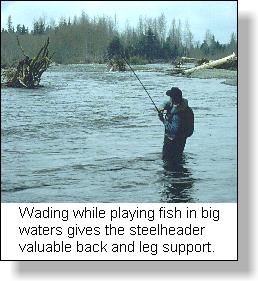 Always 'crab-walk' when you
wade! Keep your knees bent and crouch forward to give
yourself complete balance as you move across the stream.
I have found that high hip or waist deep water allows a
buoyancy which gives much greater control and balance.
Often when I am crossing a new section of river I will
wade into the stream until I am in waist deep water.
Then, following the contour of the pool, I will
walk-bob-cork downstream along the near side of the
stream until I have found the hip deep contour at the
tailout of the pool. Here is where I will then wade
across to the far streambank. Always 'crab-walk' when you
wade! Keep your knees bent and crouch forward to give
yourself complete balance as you move across the stream.
I have found that high hip or waist deep water allows a
buoyancy which gives much greater control and balance.
Often when I am crossing a new section of river I will
wade into the stream until I am in waist deep water.
Then, following the contour of the pool, I will
walk-bob-cork downstream along the near side of the
stream until I have found the hip deep contour at the
tailout of the pool. Here is where I will then wade
across to the far streambank.
Point your foot upstream when you are wading. This
gives a much smaller surface for the water to bypass and,
at the same time, it gives you a control over where each
step can be placed.
Do not turn your back on the current! This is the
position of least control! Once you have done this you
will find yourself stumbling constantly eventually to
fall in the water.
Beware of river flotsam! Small twigs, bark and
branches are a certain sign that the water level is
rising. When you see these in the river plan your
crossings carefully so that on your return you are still
able to wade back across the river.
The most dangerous water to cross is that which is
ankle or calf deep rushing over slippery cobble stones.
The danger comes from the injury you might receive when
you stumble and fall on these stones.
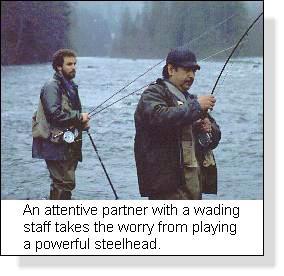 If you have a partner, cross
with one hand tightly gripped on the shoulder of each
other's coats! Holding onto shoulders gives both of you
the freedom of an arm's length to step over boulders or
other hidden underwater snags. When crossing with a
partner, the upstream angler should use a wading staff
with his free hand while the downstream angler carries
the rods in his free hand. If you are crossing a
particularly fast and forceful current, one angler should
brace himself before the other moves forward; then, the
other angler moves forward and braces himself; and so
forth, until you have negotiated the treacherous section.
Finally, when with a partner, don't release your hold
until you are both on dry ground! It is amazing how
often, in the last few feet before the bank or beach,
that you will stumble, fall, and injure yourself on
rocks. Your partner's balance is most critical during
these final few meters! If you have a partner, cross
with one hand tightly gripped on the shoulder of each
other's coats! Holding onto shoulders gives both of you
the freedom of an arm's length to step over boulders or
other hidden underwater snags. When crossing with a
partner, the upstream angler should use a wading staff
with his free hand while the downstream angler carries
the rods in his free hand. If you are crossing a
particularly fast and forceful current, one angler should
brace himself before the other moves forward; then, the
other angler moves forward and braces himself; and so
forth, until you have negotiated the treacherous section.
Finally, when with a partner, don't release your hold
until you are both on dry ground! It is amazing how
often, in the last few feet before the bank or beach,
that you will stumble, fall, and injure yourself on
rocks. Your partner's balance is most critical during
these final few meters!
Wading can give the stream angler access to all parts
of a stream often necessary to effectively cover a
fishing pool. A wading staff, your third leg, should
always be used! Felt soles and wading cleats are
particularly effective and an investment that is a must
for sound, safe and
secure river angling.
© Copyright Barry M. Thornton
Barry M. Thornton
|