B.C. OUTDOOR ODYSSEY
Pacific herring, a keystone species.
with Barry M. Thornton
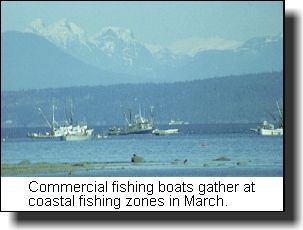 In
recent years, a concentrated human migration during mid March, the
visit of the annual herring commercial fleet, has provided a sure
sign of spring in many B.C. coastal areas. These fishers are the harbinger
of herring, a species so important to our west coast that they are
referred to as a keystone species, one upon which our west coast marine
environment and related species depend. In
recent years, a concentrated human migration during mid March, the
visit of the annual herring commercial fleet, has provided a sure
sign of spring in many B.C. coastal areas. These fishers are the harbinger
of herring, a species so important to our west coast that they are
referred to as a keystone species, one upon which our west coast marine
environment and related species depend.
Herring are one of those fascinating wildlife species who rely upon
vast numbers and schooling for survival. They have no sharp spines
and no poisonous fins like our many rockfish species for protection.
They are not fast and streamlined like salmon species and therefore
cannot escape predators with flight. It seems that their role is to
be the breadbasket species for most marine mammals and fish species.
Not an envious position, but, one which is vital to the health of
our Pacific coast's aquatic environment. I have often told my fishing
partners that, above all else, when I return in my next life, I pray
that it will not be as a herring.
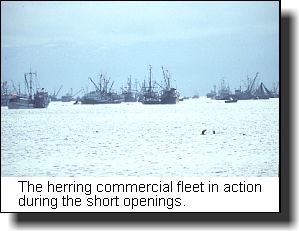
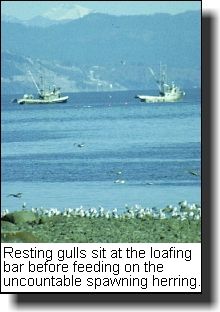 It
has been interesting these past few years to watch the 'herring furore'
in coastal waters. Vast fleets of highly specialized commercial fishing
vessels accompanied by white skies of sea gulls have been a common
sight in some communities. As well, new predators have entered the
fray in these 90's, herds of sea lions and seals. Sadly, when these
efficient marine predators have been satiated with herring, they have
turned on the few returning winter steelhead, decimating runs of these
now rare sports fish. In fact, so rare are these steelhead, that,
contrary to Fish & Wildlife provincial policy, some river species
like the Puntledge river winter steelhead have had the male sperm
'gene banked' in a process called cryopreservation for fear of their
extinction. It
has been interesting these past few years to watch the 'herring furore'
in coastal waters. Vast fleets of highly specialized commercial fishing
vessels accompanied by white skies of sea gulls have been a common
sight in some communities. As well, new predators have entered the
fray in these 90's, herds of sea lions and seals. Sadly, when these
efficient marine predators have been satiated with herring, they have
turned on the few returning winter steelhead, decimating runs of these
now rare sports fish. In fact, so rare are these steelhead, that,
contrary to Fish & Wildlife provincial policy, some river species
like the Puntledge river winter steelhead have had the male sperm
'gene banked' in a process called cryopreservation for fear of their
extinction.
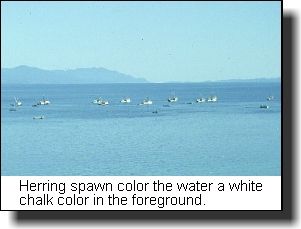
Herring have a fascinating life cycle. The average female herring
spawns 20,000 eggs while the male herring spawns millions of minute
sperm. While standing on a coastal bluff overlooking the Strait of
Georgia during a March spawn, I was astounded at the vast hectares
of milky white water along the beach, opaque and creamy from the enormous
spawn. It was impossible to even guess the incredible numbers of herring
required to create this unique sight.
 Unlike
salmon who die after spawning, herring reach maturity after three
years and, will usually spawn every year afterwards until they reach
'old' age at 8 or 10 years. Also, unlike salmon, herring do not necessarily
return to their natal site to spawn ( salmon return to their home
stream to spawn) but, rather, according to the Department of Fisheries
and Oceans; "They quite commonly spawn in one particular location
for several years, switch to another site to spawn for a number of
years and then return to the original location as much as a decade
later. The reason for this phenomenon is unclear but may be related
to localized variations in environmental conditions." Unlike
salmon who die after spawning, herring reach maturity after three
years and, will usually spawn every year afterwards until they reach
'old' age at 8 or 10 years. Also, unlike salmon, herring do not necessarily
return to their natal site to spawn ( salmon return to their home
stream to spawn) but, rather, according to the Department of Fisheries
and Oceans; "They quite commonly spawn in one particular location
for several years, switch to another site to spawn for a number of
years and then return to the original location as much as a decade
later. The reason for this phenomenon is unclear but may be related
to localized variations in environmental conditions."
 During
the actual spawning process females usually discharge sticky eggs
onto living plants such as eelgrass, rockweed and kelp. It has been
estimated that one square inch of seaweed may be covered by as many
as 1000 transparent eggs. Depending upon water temperature, hatching
into a larval stage occurs in 2 to 3 weeks. Surprisingly, the 1/2
cm long larvae bear little resemblance to the adult fish. They lack
scales, the head and black eyes are greatly enlarged and, they can
barely swim. Mortality is greatest at this stage and may be as high
as 99%. During
the actual spawning process females usually discharge sticky eggs
onto living plants such as eelgrass, rockweed and kelp. It has been
estimated that one square inch of seaweed may be covered by as many
as 1000 transparent eggs. Depending upon water temperature, hatching
into a larval stage occurs in 2 to 3 weeks. Surprisingly, the 1/2
cm long larvae bear little resemblance to the adult fish. They lack
scales, the head and black eyes are greatly enlarged and, they can
barely swim. Mortality is greatest at this stage and may be as high
as 99%.
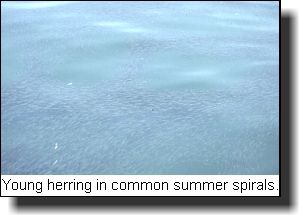
During the next 2 months a gradual metamorphosis takes place. By
the time the fish has grown to a length of 4 cm it's outward appearance
has changed into that of a miniature adult herring. Schooling begins
and the young herring, are usually found in the shallow water of bays
and inlets and near kelp beds during the summer months. It is estimated
that only one herring from 10,000 eggs matures to adult size to repeat
the spawning act of the parents.
 Adult
herring are migratory in nature although a few minor stocks remain
within the confines of coastal bays and inlets. Herring spawned in
the Strait of Georgia migrate to the banks off the lower west coast
of Vancouver Island. They leave these rich offshore feeding grounds
in the late fall or winter and migrate back to inshore waters to spawn
in March and April. Adult
herring are migratory in nature although a few minor stocks remain
within the confines of coastal bays and inlets. Herring spawned in
the Strait of Georgia migrate to the banks off the lower west coast
of Vancouver Island. They leave these rich offshore feeding grounds
in the late fall or winter and migrate back to inshore waters to spawn
in March and April.
According to the Department of Fisheries & Oceans (DFO), the roe
herring fishery in the Strait of Georgia, "is directed on migratory
stocks" with a management strategy, "to ensure that 80% of the fish
spawn". Further, they state, "The Strait of Georgia herring stock
has experienced above average recruitment in five of the last seven
years resulting in near historically high levels of abundance. A total
of 131 kilometres of herring spawn was measured in the Strait of Georgia
in 1996."
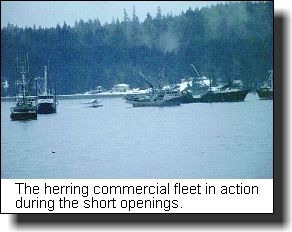
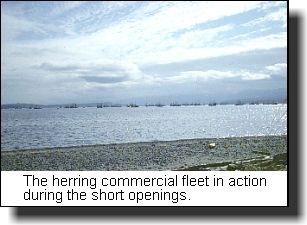
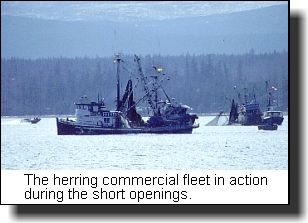
This past March, the Strait of Georgia commercial herring fishery
was confined to Area 14 with most catches occurring in waters north
of the Denman and Hornby Gulf islands. DFO Fisheries Officers reported
that there were 63 Seine vessels in the fleet and 328 Gillnet vessels.
The seine fleet had a one hour and 29 minute opening on March 4th
and made a 'hail' catch of 9410 tons of herring. The gill net fleet
had a 7 hour opening on March 19th and finished with a 'hail' catch
of 6294 tons of herring. A conservative estimated cash value of this
catch, at approximately $2500 a ton, is over $30 million. There can
be no doubt that this silver bounty is one of our west coast's most
unique and precious assets.
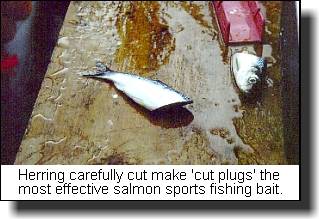 While
herring are a valuable economic species, there is repeated concern
expressed about this commercial fishery and the effect it has on the
ecology of coastal areas. Will the loss of biomass affect the saltwater
environment like the loss of spawning salmon biomass affects the growth
of newborn salmon? Is this the reason why some salmon species like
coho no longer use the Strait of Georgia as a growing zone? Only time
will tell, but, what is known is that the herring is a west coast
keystone species and must receive intensive study and a conservative
management strategy. While
herring are a valuable economic species, there is repeated concern
expressed about this commercial fishery and the effect it has on the
ecology of coastal areas. Will the loss of biomass affect the saltwater
environment like the loss of spawning salmon biomass affects the growth
of newborn salmon? Is this the reason why some salmon species like
coho no longer use the Strait of Georgia as a growing zone? Only time
will tell, but, what is known is that the herring is a west coast
keystone species and must receive intensive study and a conservative
management strategy.
More Photos
Photo1 | Photo2
| Photo3 | Photo4
© Copyright Barry M. Thornton
Barry M. Thornton
|