
Saltwater Fly Fishing Series
Dual Purpose Equipment for Salmon and Steelhead Flyfishing
with Barry M. Thornton
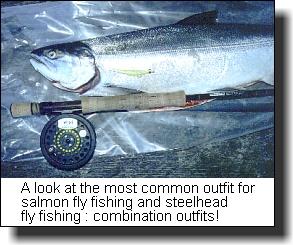
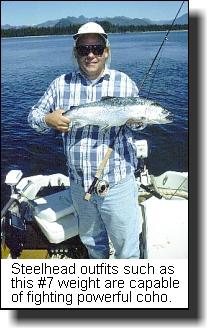 When I have been discussing steelhead and salmon fly fishing opportunities
at fly fishing clubs and sports shows, equipment costs have been a
repeated concern expressed by many anglers. Fortunately, for the pocketbook,
fly fishing equipment used for saltwater salmon fly fishing can also
be used for river steelhead fly fishing! Length of fly rod (9 to 10
ft); ASA rating for fly rods (ASA #7 to #9); fly reels ( size 7 to
10); fly lines (sink tips, shooting heads, floating, wets); all, can
be used equally effectively for both target species and in most situations.
From my personal experiences I have found that it is only with the
flies used for salmon or steelhead that there is a major difference.
But, even then, I have found that many steelhead fly patterns can
be interchangeable when fishing for some salmon species like pinks
and sockeye.
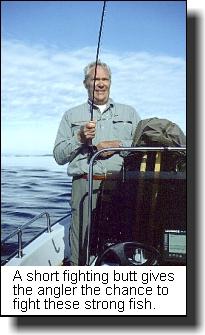 When
I began serious saltwater fly fishing for salmon I had already purchased
quality equipment which I had been using for summer and winter steelhead.
Because of this, when first experimenting on the saltchuck, I found
myself able to cast and retrieve my fly lines in a manner which I
soon found required only slight modification to become effective for
catching salmon. When
I began serious saltwater fly fishing for salmon I had already purchased
quality equipment which I had been using for summer and winter steelhead.
Because of this, when first experimenting on the saltchuck, I found
myself able to cast and retrieve my fly lines in a manner which I
soon found required only slight modification to become effective for
catching salmon.
The dual purpose fly rod
The one characteristic I would recommend for your dual purpose fly
rod would be that it have a stiff and strong spine. Noodle action
or mooching action fly rods are not what you need! Your rod should
be rated by the American Sportsfishing Association, ASA, to handle
a #8 or a #9 fly line. Salmon and steelhead are powerful trophy fish!
Anything less than a #8 will have you fighting from the reel with
the tip pointed at the fish. The only exceptions to the #8/#9 rule
would be the use of a #6 or #7 rated fly rod when river fly fishing
for coho 'Jacks' ( and a very limited number of 'Jills') during late
autumn. It is an experience I would recommend highly for all fly anglers.
Another exception would be when you are fly fishing for pink salmon
along beaches and in estuary situations. These smaller coho and pinks
defeat the sporting purpose of the powerful #8 and #9 fly rods. My
preference for these smaller salmon is a #6 weight strong spined fly
rod. In fact, it is the same fly rod I use when I fish trophy Interior
lakes for large rainbows. For sporting pleasure, and to reduce the
strain that a powerful fish will put on your 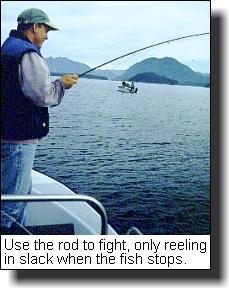 wrist,
a detachable 'fighting butt' should also be a part of the fly rod
you purchase. wrist,
a detachable 'fighting butt' should also be a part of the fly rod
you purchase.
The versatile fly reel:
There are many many fly reels on the market ranging in prices to
fit all pocketbooks. Unlike trout fishing where the reel's primary
purpose is to hold your fly line, the salmon/steelhead fly reel is
the key fighting tool in your equipment. Regardless of fish size,
and, regardless of whether I have hooked a steelhead or a salmon,
I always, always, reel in my slack fly line before I attempt to fight
the fish. Once 'at the reel' I feel I have some control over these
large fish, and, I can let them run from the reel whenever they resist
the fighting action of my fly rod. Make certain when you first spool
on your backing that it is tight to the drum of the reel. The tension
from a powerful fighting fish will have your fly line tangle under
this backing if it is not tight. Never use monofilament line as backing.
Spare spools are highly recommended which carry alternate lines for
quick in-field changes. If you are expecting to be a serious salmon
or steelhead fly fisher make the reel your most important tackle purchase!
Dual purpose flies:
 As
a rule of thumb, I use "SILVER" patterns for salmon and, "PINK" attractor
patterns for steelhead. But, if you were to look into any of my many
fly boxes you would see that there is variety! How often, in many
situations I have found that the unorthodox, the unbelievable, the
undefinable, the unreasonable, that strange fly was the fly that took
fish on that particular day. It is for that reason that I carry a
wide selection of patterns, from optics to lead eyes, from streamers
to attractors, from dries to bombers, to ensure that I have covered
all situations. I strongly believe that you can never have too many
flies! As
a rule of thumb, I use "SILVER" patterns for salmon and, "PINK" attractor
patterns for steelhead. But, if you were to look into any of my many
fly boxes you would see that there is variety! How often, in many
situations I have found that the unorthodox, the unbelievable, the
undefinable, the unreasonable, that strange fly was the fly that took
fish on that particular day. It is for that reason that I carry a
wide selection of patterns, from optics to lead eyes, from streamers
to attractors, from dries to bombers, to ensure that I have covered
all situations. I strongly believe that you can never have too many
flies!
As an experimenting fly tier, I do feel that there are some similarities
between salmon and steelhead flies. First, because you must get your
fly down to the depth which the fish prefer, salmon at 15 to 30 feet;
steelhead at the bottom of the river pool, the majority of my wet
flies are weighted. This I have found over the years is the only certain
way of getting my fly to the depth where these trophies lie. Secondly,
I use stainless steel hooks for the majority of my wet flies, 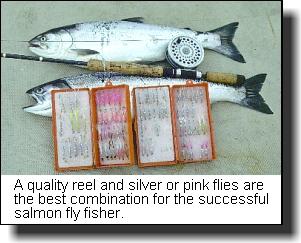 Mustad
#34007SS or the long shank #34011SS. These hooks do add weight and
help to get my flies down. Anyone who has tied a box of nonstainless
steel hooks and looked in your box after a day on the saltchuck will
understand why you use stainless steel, always! Mustad
#34007SS or the long shank #34011SS. These hooks do add weight and
help to get my flies down. Anyone who has tied a box of nonstainless
steel hooks and looked in your box after a day on the saltchuck will
understand why you use stainless steel, always!
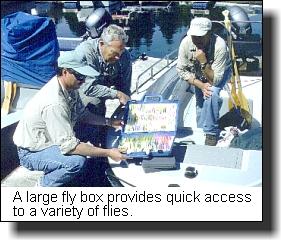
I have found that it is best to have different sized fly boxes for
each species. When river fishing for steelhead, small fly vest boxes
are most desirable and these are easily accommodated by the numerous
pockets in most vests. However, on the ocean, a single large box is
preferred because you will rarely wear a vest. This large box does
allow your selection to be fully displayed when you are making a choice
and does allow you to tie flies of different sizes to accommodate
water conditions and baitfish sizes. I use two large boxes in by boat,
one for unweighted flies and the other for weighted flies.
 While
dual equipment will solve the cost element in your fishing equipment,
there will come the time when you will find that each situation, each
species, requires a particular set of equipment. This is but one lure
to flyfishing, in fact with any specialized sport. Each year I add
at least one new rod, one new reel, and, a number of fly lines to
my repository of tackle. Each winter I will spend hours inventing
new patterns and tying the tried and proven. This is the grand appeal
to fly fishing, likely the reason why it is the fastest growing outdoor
sport in North America. While
dual equipment will solve the cost element in your fishing equipment,
there will come the time when you will find that each situation, each
species, requires a particular set of equipment. This is but one lure
to flyfishing, in fact with any specialized sport. Each year I add
at least one new rod, one new reel, and, a number of fly lines to
my repository of tackle. Each winter I will spend hours inventing
new patterns and tying the tried and proven. This is the grand appeal
to fly fishing, likely the reason why it is the fastest growing outdoor
sport in North America.
© Copyright Barry M. Thornton
Barry M. Thornton
|