BC Outdoor Odyssey
"An Odyssey or a Migration"
with Barry M. Thornton
 I have always had a deep interest in wildlife
activity. This is intensified in the fall when annual
migrations begin for they give me a chance to observe
migrating wildlife in great numbers. One experience I
will never forget occurred when I first entered
university. I had registered in a natural science class
and was eagerly looking forward to learning more about
wildlife migrations. You can well imagine my astonishment
when the professor provided the following explanation for
bird migrations; "Birds migrate because their
parents migrated, and, their parents migrated because
their parents migrated". It was hardly the
scientific explanation that I expected or wanted. But,
since then, as I have become aware of ice ages, ocean
currents, jet streams, seasonal changes, photoperiodism
(light), imprinting, magnetite (a cell substance), the
earth's magnetic field and many other factors which
affect migration, I have also come to appreciate that the
professor's explanation was based upon genetic
inheritance, experience and as yet, many further
undiscovered factors. Yes, I too have come to realize
that birds migrate because their parents migrated.
Migration is the annual population shift of mammals
and birds
usually in response to seasonal changes. Light
(photoperiodism) rather than climate appears to be the
major triggering factor which makes birds begin their
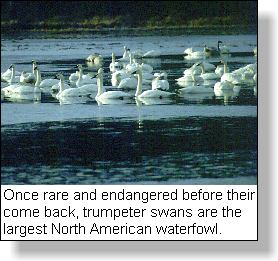
seasonal travels. One very dramatic B.C. waterfowl
example is the annual flights of the Trumpeter
Swans. Small family flocks can be predicted to first
appear after the middle of October. Flocks of these, the
largest North American waterfowl, appear in great numbers
through November and during the winter. B.C. coastal
estuaries and marine climate regions like Vancouver Island
winter the largest Pacific flyway concentration of
Trumpeter Swans, a bird that was once listed as rare and
endangered.
 Bird
migration often has interesting seasonal adjustments. The
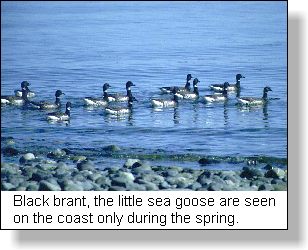
small sea goose, the Black Brant,
migrates north through the Strait of
Georgia and is a striking yet commonly seen coastal
bird beginning each April. However, in the autumn, Black
Brant migrate south along the outer coast, almost along
the continental shelf until they reach the Olympic
Peninsula in Washington state. None travel south in the
Strait of Georgia, the route they used in their spring
northerly migration. Why? Because this is the ancient
route of their parents. Bird
migration often has interesting seasonal adjustments. The
small sea goose, the Black Brant,
migrates north through the Strait of
Georgia and is a striking yet commonly seen coastal
bird beginning each April. However, in the autumn, Black
Brant migrate south along the outer coast, almost along
the continental shelf until they reach the Olympic
Peninsula in Washington state. None travel south in the
Strait of Georgia, the route they used in their spring
northerly migration. Why? Because this is the ancient
route of their parents.
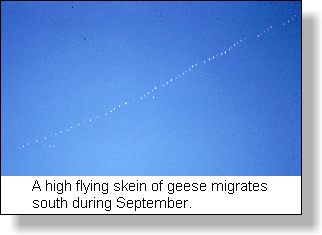
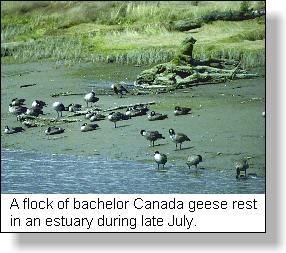
Waterfowl migration for many species occurs when the
young are capable of long distance flying. This is the
case with Trumpeter swans. It is also the situation with Canada
Geese and other geese species who begin to be heard
in September. Often long skeins or 'V' flocks can be
watched in the late summer blue skies. Why then, you may
ask, are there large flocks of Canada Geese arriving in
mid summer. The answer relates to the sexual maturity of
these birds. These early birds are in fact 'bachelor'
flocks composed of sexually immature geese of from one to
three years in age. These are not the family flocks of
mature adults and young of the year which have to wait
until the young are capable of long distance flying.
Geese do not mate until they are four years old and then,
they will mate for life with both parents sharing equally
in the raising of the annual brood of goslings.
Bird migration is not just a seasonal north-south
movement. Many ducks like scooters will nest in the
interior of the province and merely move to the coast for
the winter, performing an east-west migration.
 In many
cases there is also vertical migration from higher
mountain ranges to valley bottoms as is performed by the
province's official bird, the Steller's Jay. Then there
is that oddity, the Blue Grouse, who migrates in reverse
by moving down the mountain in the spring to nest and
then travels up the mountain in the fall to the
sub-alpine areas where it winters feeding on the needles
of coniferous trees. In many
cases there is also vertical migration from higher
mountain ranges to valley bottoms as is performed by the
province's official bird, the Steller's Jay. Then there
is that oddity, the Blue Grouse, who migrates in reverse
by moving down the mountain in the spring to nest and
then travels up the mountain in the fall to the
sub-alpine areas where it winters feeding on the needles
of coniferous trees.
Mammals also migrate in many ways. Their movement is
also based upon light but it is affected also by changing
seasonal weather patterns. Ungulates like caribou
and elk
may travel long distances from summer pastures high in
watershed mountain slopes to timbered valley bottoms. On
the other hand sheep
and goats
travel up mountains in the winter seeking snow blown
slopes where they can feed, and, as protection from
wolves and other predators.
One misnomer that is in common use is to refer to the
return of salmon as a migration. In actual fact it is an
odyssey, a long wandering journey rather than the
seasonal shift from one location to another. The salmon
odyssey is a term I prefer for it conjures up an
impressive life journey. Some salmon, including steelhead, will
take up to five, six or even seven years to travel the
open Pacific Ocean before they return to spawn. We know
that all five west coast Pacific Salmon species die
following spawning adding their vital nutrients to the
stream to nourish hatching fry. Steelhead however, will
often survive and complete a second and even third
journey out to the open ocean then back to their natal
stream.
 A migration
or an odyssey? British Columbians have an unique
opportunity to watch many wildlife species in their
annual movements from one location to another. To be so
fortunate to observe the behaviour of wildlife in a
province which has our country's greatest variety is a
fascinating, intriguing and enchanting experience. When
next you hear the call of the goose; or, see the blow
from a whale; or, watch struggling salmon in a stream;
or, provide winter bird feed for those sassy Steller's
jays in your backyard, remember that until scientists can
provide a definitive answer to migration, they are there
because their parent's were there. A migration
or an odyssey? British Columbians have an unique
opportunity to watch many wildlife species in their
annual movements from one location to another. To be so
fortunate to observe the behaviour of wildlife in a
province which has our country's greatest variety is a
fascinating, intriguing and enchanting experience. When
next you hear the call of the goose; or, see the blow
from a whale; or, watch struggling salmon in a stream;
or, provide winter bird feed for those sassy Steller's
jays in your backyard, remember that until scientists can
provide a definitive answer to migration, they are there
because their parent's were there.
© Copyright Barry M. Thornton
Barry M. Thornton
|