
BC Outdoor Odyssey
"Fishing with Floats"
with Barry M. Thornton
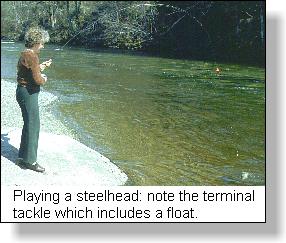 Over the years floats have played a very
important part in my fishing career. From the time I can
first remember I used bottle corks for whitefish and
bullheads. Then I remember the white and red floats I
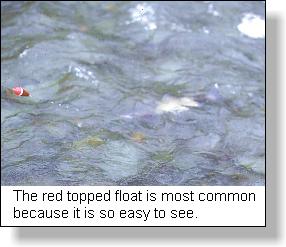
used for lake trout. Next, I graduated to red topped cork
floats common for steelhead. Finally, I experimented with
subtle drifting torpedo floats in kelp beds for coho.
Above all, floats have added a dramatic visual experience
to my fishing.
One of my favourite home films is a short clip on a
super 8 film (remember Super-8 films?) that shows the
dramatic take of a steelhead. But, it is not the fish you
see on the film. Rather it is the take down of the float
when the steelhead took my Gooey-bob lure drifting about
four feet under the float. The film shows the steady
drift of the float as it travels down the pool; the
slight hesitation in the drift as the steelhead obviously
mouths the lure and drifts downstream with it; then the
brightly coloured float suddenly disappears in tannin
river waters. The clip is neither artistic nor dramatic
but, for me, it is the anticipation I feel when I watch
the sequence for I know, it is, 'Fish on'!
 My first experiences with floats
came with the usual bobber and worm in a small lake. I
was a novice at fishing at that time, still in my preteen
years, but, I can still remember the intensity I felt
watching the innocent red and white cork, waiting, just
waiting for it to show some movement. In recent years I
continue to feel that same intensity as I watch strike
indicators (miniature floats) on my fly fishing leaders
while stillwater chironomid trout fishing or steelhead
river fly fishing. My first experiences with floats
came with the usual bobber and worm in a small lake. I
was a novice at fishing at that time, still in my preteen
years, but, I can still remember the intensity I felt
watching the innocent red and white cork, waiting, just
waiting for it to show some movement. In recent years I
continue to feel that same intensity as I watch strike
indicators (miniature floats) on my fly fishing leaders
while stillwater chironomid trout fishing or steelhead
river fly fishing.
Over the years I have marvelled at the variety of
floats available and the ingenuity of anglers in their
use of this simple fishing tool for successful fishing.
While travelling in France last year I was astounded to
see a complete wall of various fishing floats in a
village sports fishing store.
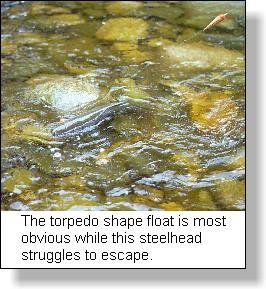
One of the more successful floats is the transparent
torpedo float which is used to fish flies with spinning
tackle. This clear plastic float provides the weight
needed to cast and at the same time keeps the fly near or
on the surface where it is most effective. The torpedo
float is simply tied to the end of your line and then a
short or long leader is tied to the other end of the
float to which is tied the fly of choice. Pink salmon
found along beaches and estuaries in August rarely take a
lure and are very difficult to fish in shallow beaches.
But, they will actively take a small pink fly much to the
pleasure of fly fishermen. The clear torpedo float is the
solution for spin fishermen as they have found that they
can cast on the shallow beaches and use that one lure, a
pink fly, which is most successful for these spunky
salmon.
 In recent years strike
indicators have become standard for fly fishing when
specific depths are required for your flies. These
indicators vary from small foam balls to miniature
torpedo floats. I like to use Spin and Glo lures with
their wings clipped as my floats, because they are highly
visible, cast well, and are easily moved up and down my
leader if I need to vary depths. Today, strike indicators
are common for chironomid fishing for trout and for some
steelhead or river salmon fly fishing situations. In recent years strike
indicators have become standard for fly fishing when
specific depths are required for your flies. These
indicators vary from small foam balls to miniature
torpedo floats. I like to use Spin and Glo lures with
their wings clipped as my floats, because they are highly
visible, cast well, and are easily moved up and down my
leader if I need to vary depths. Today, strike indicators
are common for chironomid fishing for trout and for some
steelhead or river salmon fly fishing situations.
Steelhead float fishing has given me a wealth of
experiences - my intensity is such that at night I often
fall asleep recalling the day's imprinting of the many
float drifts on that particular day. My float fishing
techniques have changed little from those I first tried
decades ago. In fact, I float fish for steelhead in the
same fashion that I did for trout and whitefish in North Okanagan rivers
where I grew up. The only difference today lies with the
artificial lures that I use.
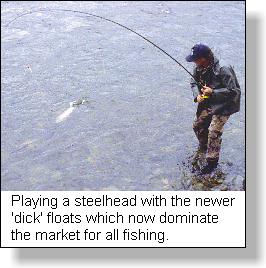
While methods have not changed, floats have gone
through a striking evolution; from cork to plastic; from
balsam wood to foam. The most common float used today for
steelheading is the 'dick' float, a six inch long foam
tube, an economic rather than practical choice. Wood
floats have become very pricey and plastic will break
when it strikes river rocks - hence, we have small
tubular foam floats as the replacement. However, I still
prefer the teardrop torpedo wooden floats because they
give me a greater view of that 'take' when it comes.
 Sitting in your boat watching
torpedo floats drift with the tides, knowing that at any
moment a salmon will snatch your bait, has to be one of
the most exciting float fishing experiences. I have done
this on a number of occasions while I fish for feeding
coho or chinooks using the same red-topped floats that I
use for steelheading . It is always a heart-stopper when
the float suddenly disappears and at times, even before
you can grasp your rod, a chrome bright coho leaps and
prances across the waters behind the boat. It is one
float fishing experience that I would recommend all
anglers try. I know that with your first fish you will be
hooked. Sitting in your boat watching
torpedo floats drift with the tides, knowing that at any
moment a salmon will snatch your bait, has to be one of
the most exciting float fishing experiences. I have done
this on a number of occasions while I fish for feeding
coho or chinooks using the same red-topped floats that I
use for steelheading . It is always a heart-stopper when
the float suddenly disappears and at times, even before
you can grasp your rod, a chrome bright coho leaps and
prances across the waters behind the boat. It is one
float fishing experience that I would recommend all
anglers try. I know that with your first fish you will be
hooked.
Likely the most important aspect of float fishing is
that it provides an excuse for an action filled family
outdoor adventure with few snags. Casting floats is easy
and requires only the basic fishing tackle. Lures can be
natural, those found under logs or dug from the ground.
But, best of all, when the fish are reluctant to bite,
floats can be left, but, attended by those who still have
a limited attention span. Then, when that red topped cork
bobs, everyone can see and share in the action. Floats in
all their variety provide a visual experience that few
other fishing techniques can match. Next time you are on
the water, experiment with a float, you may be astounded
at how successful you can be.
© Copyright Barry M. Thornton
Barry M. Thornton
|