There
are a couple of varieties of the Lodgepole Pine
known as Black Pine, Scrub Pine, Shore Pine, Coast
Pine
Lodgepole
Pine is British Columbia's only native two-needled
conifer
Lodgepole
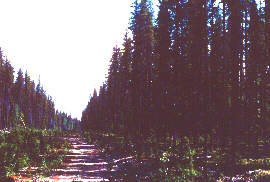
Pineis the most widespread tree in the province
Along
the treeline and the Pacific Coast, the tree is
often contorted and shrubby hence the name Pinus
Contorta
Lodgepole
Pine is susceptible to mountain pine beetle attacks,
mistletoe, rusts and root rot
UNIQUE
FEATURES:
the
cones need extreme heat (eg from a forest fire)
to open and release the seeds
cones
can remain on the branches for many years
the
trees provides food for small mammals which feed
on the inner bark
LOCATION:
Lodgepole
Pine is found throughout most of the province
Lodgepole
Pine occurs from the coastal to subalpine sites
Lodgepole
Pine can grow in all sorts of environments; from
water-logged bogs to dry sandy soils
SIZE:
tall
and slender
CONES/FRUIT:
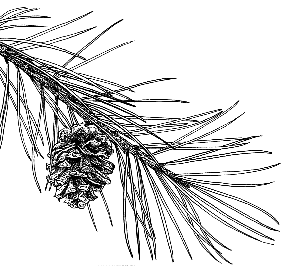
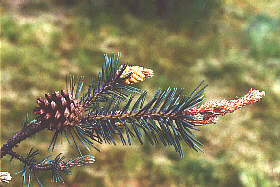
vary
in shape; short and cylindrical to egg-shaped
2
to 4 cm
scales
has sharp prickles on the ends
covered
with seal of pitch
NEEDLES:
occur
in pairs
are
long and green with sharp ends
BARK:
thin,
scaly
orangey-brown
to grey
WOOD
CHARACTERISTICS:
Lodgepole
Pine is a soft wood but excellent for a variety
of uses
USES:
modern
- plywood, paneling, furniture, doors, windows,
fence posts, railway ties
traditional
- wood: building poles; inner bark: strips of this
were eaten fresh in spring or stored, mashed to
make bread; pitch: as a base for medicines, poultices,
chewed to relieve sore throats; needles: tea
QUICK/EASY
ID (indentification) for LODGEPOLE PINE
cones:
pokey, prickly, pitchy
needles:
pointed, paired
bark:
patchy
general:
pioneer species (first to grow after a disturbance
such as a fire)



 NEEDLES:
